
AI insights
-
What does the phrase "If you meet the Buddha, kill the Buddha" mean in this article?
It means that the so‑called Buddha is any untouchable method, framework, playbook, tool, or process that promises certainty. In product work, that preconceived solution often comes as a consultant or leader who wants to understand the current process and establish a new one.
Topic focus: Core Claim -
Why is clinging to a fixed process a problem in organizations?
The article notes that leadership often wants a fix that doesn’t require leadership to change, while delivery becomes late and people are tired. This reframing shows why simply swapping processes without changing underlying behavior is insufficient.
Topic focus: How To -
What is the core takeaway about processes versus judgment?
The core claim is that the process (the Buddha) isn’t sacred; treating it as untouchable leads to stagnation. The article advocates using judgment to navigate chaos rather than relying on a fixed process.
Topic focus: Definition -
What practical implication does this article offer for leaders facing change?
It suggests leaders should not treat the current process as inviolable and should instead apply judgment to adapt to evolving conditions, avoiding comfort-driven rigidity.
Topic focus: How To -
Can you cite a concrete example of the problem described?
In large enterprises, a consultant or new leader is brought in to “understand the current process” and “establish a new one,” which the article ties to late delivery and tired teams.
Topic focus: How To -
Where can I find frameworks for real transformation and guidance on when to bring in outside help?
See Change Isn’t the Enemy, Comfort Is, which discusses frameworks like Kotter’s and Kaizen and explains why sometimes an outsider is exactly what a company needs to move forward.
-
How does the article connect to broader ideas about ideas and systems?
The Spiral Climbs: Ideas Are Expensive, Systems Are Cheap notes that in 2025 systems and patterns are cheap and speed has a brain, but judgment remains essential, reinforcing the call to move from fixed ideas toward adaptable systems with good judgment, as echoed in the primary piece.
Topic focus: How To
- Meet the Buddha to kill the Buddha, Linji would say.
- In business speak, Buddha is the sacred process that promises certainty, a lanyard you cling to while reality keeps changing.
- Interviews, artifacts, and ceremonies become a ritual shield, proving you followed the steps while delivery slips.
- The truth whispers in hallways: that’s how we’ve always done it.
- So you ship the same old cycle, calling it governance.
- The fix?
“If you meet the Buddha, kill the Buddha.” — Linji (Rinzai)
This line isn’t here to sound profound. It’s a crowbar.
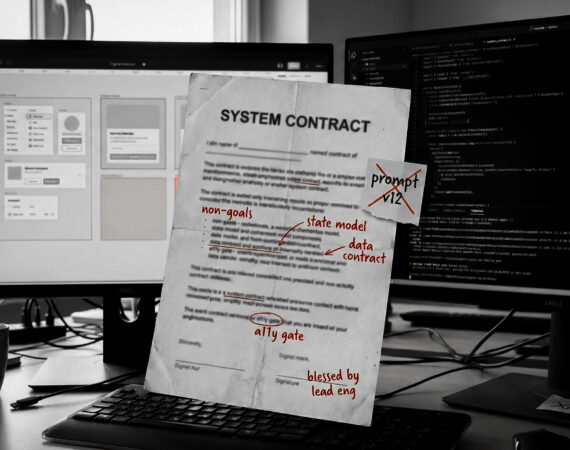
“Buddha” isn’t a man in gold. It’s whatever you’ve decided is untouchable: the method, the framework, the playbook, the tool, the blessed process that supposedly turns chaos into certainty.
In product work, that Buddha usually has a lanyard.
In large enterprises, the scene plays on repeat. A consultant or a new leader is brought in to “understand the current process” and “establish a new one.” Translation: delivery is late, people are tired, and leadership wants a fix that doesn’t require leadership to change.
So, you do the interviews. You collect the artifacts. You sit through the ceremonies. You watch the same work get discussed, blessed, re‑blessed, and delayed until it’s cold. Then someone lets the real truth slip. Always in a hallway, always quiet, like a confession:
“That’s how we’ve always done it.”
And if you hang around long enough, you’ll hear the supporting hymns:
- “We need to wait for the next planning cycle.”
- “That’s not in the current governance model.”
Not reasons. Ritual phrases. Doors that close.
People love it because it’s safe. Safety beats outcomes. If you follow the steps, you’re protected. When things go wrong, nobody has to say, “We made a bad call.” They just say, “We followed the process.”
That’s the part nobody writes in the “Operational Excellence” decks: process becomes an alibi. A liability shield. A way to avoid ownership while looking responsible. And once the process becomes sacred—once questioning it becomes “muddying the waters”—you’re not managing work anymore. You’re managing belief.
The Pilot Paradox
So the only move left is to stop debating and run a test.
A pilot division gets carved out. The process is treated like what it actually is: a hypothesis. Handoffs get reduced. Decisions move closer to the people doing the work. Feedback loops get shorter. “Approval” gets replaced with “evidence.”
The results aren’t poetic. They’re practical. Faster deadlines. Less rework. Better collaboration. Teams get recognized. Awards land. People stop living in perpetual pre‑mortems.
And then, even with the wins sitting right there on the table, the Buddha speaks again:
“The results are amazing. But let’s stick to the old process. No need to muddy the waters. Everyone needs to be happy with it.”
That’s the enterprise tragedy in one sentence. Because at that point, you’re not fighting a workflow. You’re fighting identity. Some people don’t want a better system. They want the old system to remain true because their status, safety, and story depend on it.
This is where the bill comes due: high performers leave. The people who can see reality stop arguing with the building and just walk out. What’s left is compliance, cynicism, and a very expensive kind of calm.
Why this moment is different
Iteration got cheap.
We live in a time where you can prototype a product without committing to a product, and you can prototype a way of working without turning it into corporate law. You can test a workflow the same way you test an interface: in a sandbox, with real constraints, with feedback, with the option to kill it quickly.
You don’t need six months of governance theater to try a two‑week operating model. The cost of a failed experiment is a rounding error. The cost of a dead process is your company’s future.
And yes, AI is part of this. Used well, models are a pressure cooker for options: draft the first version of a process, generate edge cases, role‑play failure modes, propose alternatives, summarize what the team is actually saying under the polite words. They make the first pass cheap, so you stop treating the first pass like scripture.
But don’t turn around and build a new shrine. The industry is already doing the idol swap:
- Old Buddha: “The process says…”
- New Buddha: “The model generated…”
Same surrender, different costume. AI is not wisdom. It’s velocity. And velocity without direction is just getting lost faster. If your thinking is sloppy, AI will help you ship sloppy faster. If your incentives are rotten, AI will help you scale rot.
Runtime Process
So here’s the grown‑up version of “process without a process”: runtime process.
Most corporate processes are compile‑time: decided months in advance by people far from the blast radius, then enforced like scripture. Runtime process is the opposite: you adjust based on live data.
Rebellious acts:
- It is killing a meeting 20 minutes early because the decision is made, and giving people their time back.
- It is deleting a template after two uses because it adds paperwork, not clarity.
- It is running a two‑week experiment, measuring cycle time and rework, and saying, “That didn’t work. Next.”
That’s it. No incense.
Linji’s point is simple and unforgiving: the moment you outsource your judgment, you lose the only advantage you have. Not your tools. Not your frameworks. Your ability to see what’s in front of you.
So kill the Buddha.
Kill the process you worship.
Kill the AI you’re tempted to worship.
Then do the hard part: stand there without the idol, without the alibi, and own the outcome.
“The fault lies in the fact that they don’t have faith in themselves!” — Linji
Note: The “kill the Buddha” line is widely attributed to Linji’s teachings.
Linji (Rinzai) was a 9th-century Chinese Chan master. Famous for teaching with verbal head-butts instead of gentle sermons. Chan (later called Zen in Japan) is Buddhism stripped down to the bone: less doctrine, less ceremony, more direct seeing. So “kill the Buddha” isn’t anti-Buddha. It’s anti-idol, anything you worship, so you don’t have to look at reality yourself.