
AI insights
-
What is the main takeaway from this article?
Anyone who has sat through a transformation steering meeting knows the ritual.
Topic focus: Core Claim -
Which core concept does the article explain?
Many AI programs do not fail the day the dashboard turns red.
-
What practical action does the article suggest?
They start failing earlier, and more quietly.
-
What supporting detail or evidence is highlighted?
A team stops escalating risk because nobody believes leadership will change course.
Topic focus: Pitfall -
What common mistake or risk should readers avoid?
A manager protects an old workflow while publicly endorsing the new one.
Topic focus: Pitfall -
What example from the article makes the idea clearer?
Validation gets rushed because the program wants momentum more than honesty.
Topic focus: Example -
What is a good next step after reading this article?
In reality, the operating conditions are already starting to break.
Topic focus: Definition
- The article argues that AI and transformation programs often start failing long before dashboards turn red, as teams hide risk, protect old workflows, and rush validation to preserve the appearance of progress.
- It presents TCE, or Team Capability Engine, as a lightweight, recurring signal layer that detects early human execution drift instead of waiting for visible delivery failure.
- TCE tracks five leading risk areas: escalation quality, dependency reliability, mandate alignment, systemic burnout, and validation integrity.
- This matters because traditional tools show tickets and milestones but miss hesitation, weak handoffs, loss of trust, and rubber-stamp AI oversight that can create governance and compliance risk.
- The system is designed as exception-based monitoring, surfacing meaningful drift early so leaders can reallocate support, tighten controls, adjust scope, or stop weak programs sooner.
- The article says Trust Signals only work if they protect individuals, reduce the cost of honesty, and visibly lead to better decisions rather than more management theater.
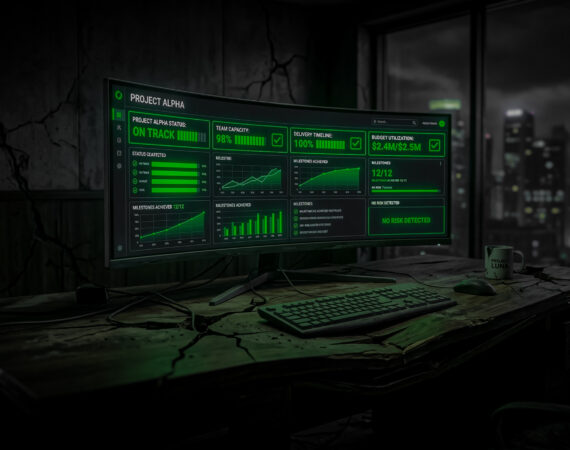
Anyone who has sat through a transformation steering meeting knows the ritual. The slides are clean. The milestones are color-coded. The task board is moving. The dashboard is green. The budget keeps burning.
That is the lie.
Many AI programs do not fail the day the dashboard turns red. They start failing earlier, and more quietly. A team stops escalating risk because nobody believes leadership will change course. A manager protects an old workflow while publicly endorsing the new one. Validation gets rushed because the program wants momentum more than honesty. On paper, the work is moving. In reality, the operating conditions are already starting to break.
That is where TCE comes in.
TCE, the Team Capability Engine, is a continuous signal layer for human execution risk. It allows leaders to intervene before drift turns into delivery failure, failed adoption, governance exposure, or wasted spend. TCE Trust Signals are not a one-time assessment. They are not another sentiment survey dressed up as strategy. They are a lightweight, recurring way to monitor whether the conditions for execution are holding, drifting, or breaking. Not once a year. Not after the postmortem. Early enough to catch meaningful drift before it becomes a visible failure.
Why This Matters
AI has made the old reporting problem worse. Traditional delivery systems are good at showing what is visible: tickets, throughput, burndown, sprint status, and release dates. They are far worse at showing what is happening underneath the work: hesitation, avoidance, mixed mandates, poor handoffs, weak validation, or the quiet loss of trust that turns a promising rollout into political theater.
Staying green is not just a reporting choice. It creates cognitive drag. When people know a program is drifting but feel forced to report progress anyway, judgment gives way to self-preservation. Productivity drops. Candor drops faster.
The Execution Gap: By the Numbers
| Metric Source | The Reality of Transformation and AI |
| Bain (2024) | Only 12% of business transformations achieve their original ambition. |
| PMI (2025) | Only half of the projects meet a modern definition of success where value exceeds effort and cost. |
| McKinsey (2024) | 65% of respondents said their organizations were regularly using generative AI in at least one business function. |
| Gartner (2024) | At least 30% of generative AI projects would be abandoned after proof of concept by the end of 2025. |
The appetite is real. So is the drop-off. The problem is not ambition. It is the lack of a reliable signal between executive intent and frontline execution. That gap is where execution risk lives.
What TCE Trust Signals Actually Watch
In practice, TCE monitors five risk vectors that move weeks before the dashboard does.
- Escalation Quality: speed of truth versus speed of staying green.
- Dependency Reliability: cross-functional handoffs under pressure.
- Mandate Alignment: detection of strategic drift and priority dilution.
- Systemic Burnout: identifying judgment-impairing strain.
- Validation Integrity: protecting the human in the loop from becoming a rubber stamp.
That last one matters more than most leaders realize.
When validation integrity collapses, “human in the loop” becomes a myth. The human is still there, but only as a rubber stamp.
A weak AI rollout does not just create adoption problems. It creates governance debt and operational liability. If teams do not trust the system, they usually do one of two things: bypass it or use it carelessly. Unverified outputs can move into documents, workflows, or decisions before the organization notices. At that point, a people problem has become a compliance and data-integrity problem.
This Is Not Another Dashboard
The immediate executive objection is obvious: do we really need another stream of metrics?
No. That is the wrong model.
TCE Trust Signals work best as exception-based signaling. The system runs lightly and continuously in the background, but the goal is not constant visibility for its own sake. The goal is low-friction detection of meaningful drift, surfaced only when execution conditions materially deviate from baseline. Attention rises when human execution health drifts far enough from the delivery baseline to matter. That is the distinction.
JIRA can tell you a ticket is stuck.
TCE can tell you the team stopped believing in the work two weeks earlier.
Operational vs. Lagging Telemetry
| Feature | Lagging Delivery Metrics (JIRA / ADO) | TCE Trust Signals (Exception Monitoring) |
| Primary unit | Task or ticket status | Execution conditions |
| Detection | “This ticket is late.” | “The team stopped believing in this goal two weeks ago.” |
| AI risk | Velocity of output | Integrity of validation and rubber-stamp risk |
| Lead time | Reactive, after work slips | Proactive, while drift is still forming |
| Executive value | Audit of what went wrong | Time to pivot, preserve capital, or kill the work earlier |
One tool tells you the fire has started. The other lets you smell smoke while there is still time to act.
Why Teams Would Tell the Truth
This only works if the signal is governed well.
Trust Signals have to be aggregated, role-bounded, and designed to protect the individual rather than expose them. If people think Trust Signals are just a cleaner way for management to watch them, the data dies. Some people go silent. Others answer strategically. Either way, leadership gets theater instead of signal.
The design principle is simple: objectify the obstacle. Instead of forcing one engineer, designer, or product lead to carry the burden of saying, “This deadline is a fantasy,” the system surfaces a visible operating exception. We do not need more brave employees. We need a system that does not require bravery to be honest. That protects the individual, lowers the emotional cost of telling the truth, and gives leadership something better than gossip or gut feel: a pattern they can act on.
That is why reciprocity matters. Teams have to see that participation removes friction. If a signal never leads to clearer priorities, better sequencing, more realistic scope, or stronger air cover, people will stop giving it to you honestly.
From Observation to Action
This is where TCE becomes decisive.
The value is not another lens on team mood. The value is time. When a system surfaces drift early, a sponsor can reallocate support before a sprint fails, add decision attention before a cross-functional dependency snaps, tighten validation before AI-generated errors become compliance risk, or adjust the mandate before another month of budget disappears into a pilot nobody really believes in.
And sometimes the right move is not more support. Sometimes it is capital preservation.
That may mean pivoting the work, reducing scope, or stopping a program that no longer has the operating conditions to succeed. Most organizations make those decisions too late because the dashboard tells them what has already happened. A trust-signal layer gives them a better chance to act while the outcome is still negotiable.
The Real Question
If you are funding AI or transformation, the question is not whether your dashboard is green.
It is whether your system still has a reliable way to tell you when green is a lie.
That is the job of TCE Trust Signals. Not to replace delivery telemetry. Not to create more noise. To monitor the human conditions that shift before the visible metrics do, and surface exceptions early enough for leadership to act with precision.
Your most expensive asset is not the model. It is the collective intelligence and honesty of the people expected to use it under pressure. If your system is optimized to ignore their signals, you are not managing a transformation. You are managing a miracle.
And miracles are notoriously hard to scale.
If the room has gone quiet, the risk has just gotten louder.
The question is not whether your dashboard is green. It is whether you have built a system that is allowed to tell you otherwise.
Key takeaways:
- Traditional delivery dashboards are reactionary. TCE Trust Signals are built to catch human execution drift earlier.
- In AI programs, weak trust does not just hurt adoption. It can weaken validation integrity, create governance debt, and turn human oversight into rubber-stamp theater.
- The commercial value of TCE is time: earlier re-allocation, earlier mandate adjustment, and earlier stop-or-pivot decisions.
If this is the blind spot you are trying to remove, the next question is not abstract. Audit where bad news gets delayed in your reporting system, where AI validation is treated as a ceremony instead of control, and where teams still need personal courage to surface operational risk. Then ask a harder question: what tells you the truth before your dashboard does?
As Margaret Heffernan wrote,
“For good ideas and true innovation, you need human interaction, conflict, argument, debate.”
In practice, that means an enterprise needs systems that can hear reality before reality turns into loss.
Sources
This article draws on research and publications from Bain & Company, PMI, McKinsey & Company, Gartner, Amy Edmondson’s work on psychological safety, Elizabeth Morrison’s review of employee voice and silence, and Margaret Heffernan’s TED work on disagreement and truth-telling in organizations. Official source links are listed below.
- Bain & Company (2024) — https://www.bain.com/about/media-center/press-releases/2024/88-of-business-transformations-fail-to-achieve-their-original-ambitions-those-that-succeed-avoid-overloading-top-talent/
- PMI (2025) — https://www.pmi.org/about/press-media/2025/new-pmi-research-reveals-strategy-execution-gap-is-undermining-transformation-and-how-to-close-it
- McKinsey & Company (2024), The State of AI in Early 2024 — https://www.mckinsey.com/capabilities/quantumblack/our-insights/the-state-of-ai-2024
- Gartner (2024) — https://www.gartner.com/en/newsroom/press-releases/2024-07-29-gartner-predicts-30-percent-of-generative-ai-projects-will-be-abandoned-after-proof-of-concept-by-end-of-2025
- Amy Edmondson (1999), Psychological Safety and Learning Behavior in Work Teams — https://dash.harvard.edu/handle/1/37968728
- Elizabeth W. Morrison (2014), Employee Voice and Silence — https://www.annualreviews.org/doi/10.1146/annurev-orgpsych-031413-091328
- Margaret Heffernan, TED Speaker Page / Dare to Disagree — https://www.ted.com/speakers/margaret_heffernan