
- AI
- AIGovernance
- Systems Thinking
The System Around the Work: Designing for Continuity and Judgment
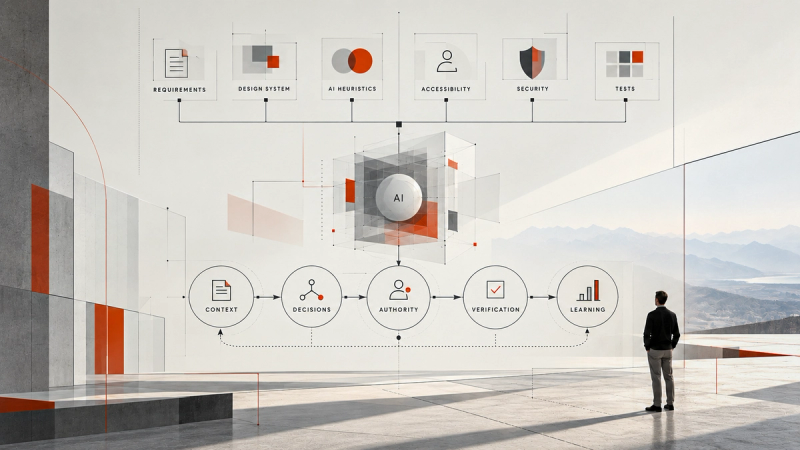
AI makes building easy. The harder problem is creating a system that preserves context, supports judgment, verifies work, and learns over time.
Briefing · AI / Orchestration / Operations
Transform your workflow with AI: Discover how we achieved a 60% faster project delivery while enhancing quality and client satisfaction at every stage.

This article showcases how integrating AI at every project phase transformed our delivery process, achieving a nearly 60% faster completion. It details AI’s role from strategy to final deployment, enhancing efficiency without sacrificing quality, and highlights key lessons learned to inform future AI-driven workflows.
Everyone is talking about AI these days, but here’s a case study of how we used it to transform a project—from strategy to final deployment.
This wasn’t an experiment; it was a deliberate approach to streamline workflows, cut down time, and boost client satisfaction. And it paid off.
With AI by our side, we wrapped up the project nearly 60% faster than usual, handed over a high-quality final product, and gained some valuable insights.
Here’s how we put AI to work, what it did for us, and why it matters.
Every project starts with strategy. Typically, this means workshops, goal-setting, and countless hours spent aligning everyone’s vision. With AI tools integrated into Miro, our go-to for workshops and tracking, we organised insights in real time. AI spotted patterns in feedback that would usually take hours to find, immediately pointing us toward a clear direction without the usual scramble afterwards.
Then came the contract phase.
Instead of the usual drawn-out process, we used our custom GPT “UXContractAI” to quickly scan the contract and Statement of Work (SOW) drafts, flag any ambiguities and suggest standard clauses to keep everything clear and streamlined.
What normally took a day or two to finalise was done in an hour. We ended up with a solid, precise contract that set the foundation for a smooth project, and everyone was aligned from day one.
AI also stepped in as our project manager. We created a custom GPT to track tasks, send updates, flagging issues—AI took on these repetitive but essential tasks with ease.
By using historical data, AI even suggested realistic timelines, keeping us one step ahead without us having to micromanage every detail. The team stayed aligned and organised, and nothing fell through the cracks.
Once contracts were signed, it was time to dive into research.
Normally, studying user data is a time-consuming process, but AI changed the game. It swiftly analysed competitor and user data, delivering insights into behaviours, preferences, and pain points we could prioritise. Instead of days spent sifting through endless data, we had a clear view of the user journey and knew exactly where to focus—all in a fraction of the usual time.
With research wrapped, we moved to ideation.
With Miro, RelumeAI and Figma, we had initial frameworks and rough wireframes ready within minutes. This gave us a running start, allowing our team to jump in with creative ideas without bogging down in basic groundwork. AI got the heavy lifting out of the way, and we could focus on bringing unique, high-impact ideas to the table.
Design and development are typically the longest, most resource-intensive stages. From visuals to coding, every task demands precision, rounds of edits, and in-depth Quality Assurance (QA) and User Acceptance Testing (UAT). But with AI, these time-consuming steps became more streamlined and efficient.
For design, we leaned on AI tools in Figma and Adobe’s Creative Suite (Photoshop and Illustrator) to create, optimise, and refine both vector and raster visuals.
Instead of manually creating icons and vector clip art, AI has allowed us to process these steps almost instantaneously. What typically took days can now be accomplished in minutes, letting us turn around high-quality visuals at record speed without sacrificing attention to detail or creative control. For example, creating a range of assets to support the editorial screen, cutting up and touching up images, or reworking colours and layouts based on feedback is now faster and easier, keeping the client’s brand consistent and polished throughout.
The development phase saw similar gains. We needed custom code for additional CMS functionality, typically a task that involves rounds of testing and troubleshooting. Instead, generative AI helped us generate, test, and refine code in about two hours—a process that usually would have stretched over a full day or more. By handling repetitive technical tasks, AI freed our developers to focus on enhancing the user experience and overall functionality.
And, like any project, we had a few hurdles.
The client delayed providing the final text for a screen, so we used another custom GPT to draft a temporary, SEO-optimized, and brand-aligned version of the copy in order to keep us moving forward. The client was not only impressed by the speed but also the quality of the draft copy.
At one point, we needed a short video created from the client’s original copy. Instead of spending hours on traditional video editing, we used AI to generate a polished video, which passed client reviews on the first go. Although the client ultimately decided not to include videos in the final delivery, using AI saved us significant time and prevented any wasted effort on edits and revisions.
This project showed us just how transformative AI can be—not only for streamlining our workflow but for enhancing quality and client satisfaction. Here’s what we learned:
The client’s response?
“The process was incredibly seamless, and the end product exceeded our expectations. It’s exciting to see how much faster and smoother things can go with a technology-forward approach.”
Their reaction highlighted the value of an AI-driven workflow and its positive impact on their experience as much as ours.
Reflecting on this project, it’s clear that AI is here to stay and only getting better.
From more precise analytics to faster content generation, AI’s possibilities are expanding. It’s no longer a question of if we should use AI but how we can use it to work smarter.
Human creativity is still the wellspring of great work. Technology only becomes powerful when it serves our ideas and insights.
This project wasn’t just about meeting deadlines; it was about pushing the boundaries of what’s possible. For organisations and clients wanting to stay competitive, AI isn’t just a tool—it’s an ally that, when used well, lets us achieve more than we thought possible.
Listen · AI-narratedSummary
0:00Keep reading
Selected from the same topics.
AI makes building easy. The harder problem is creating a system that preserves context, supports judgment, verifies work, and learns over time.

What changes when the distance between a question and what we can create to explore it begins to collapse, and judgment becomes a harder skill?

We cannot predict every way an AI agent might interpret us. The guardrail belongs where interpretation becomes a consequence.
Contact
Tell me what you are building, changing, or trying to make better. You do not need a polished brief.
Prefer email? [email protected]
I read every inquiry personally and usually reply within one business day.