
- AI
- AIGovernance
- Systems Thinking
The System Around the Work: Designing for Continuity and Judgment
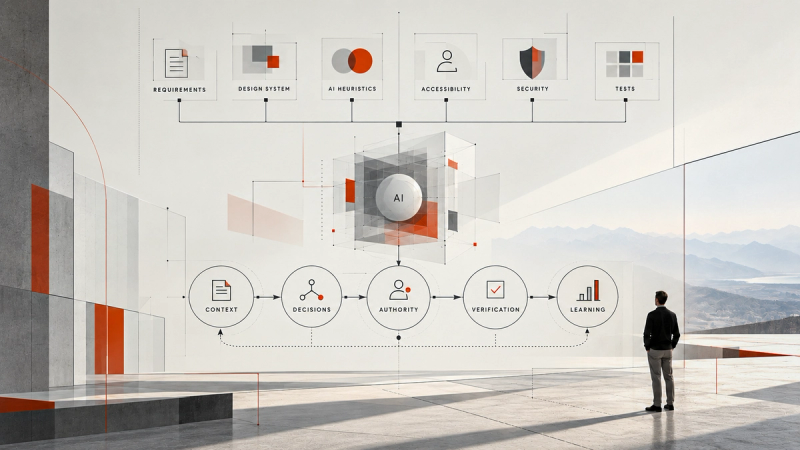
AI makes building easy. The harder problem is creating a system that preserves context, supports judgment, verifies work, and learns over time.
Briefing · Leadership / Transformation
In an age of infinite AI fluency, leaders need calibration. A one-page Decision Brief turns confidence into assumptions, evidence, and tests.

AI is excellent at turning messy thinking into fluent output. For example, an AI-generated “strategy document” can look executive-ready even when the underlying evidence is thin. That is useful and risky.
In leadership settings, fluency often gets mistaken for completeness. A plan that sounds coherent can win support before its assumptions are tested. Over time, this creates a predictable failure mode: confidence increases faster than understanding.
This post is about preventing that drift.
Think of the ritual below as speed insurance: 15–20 minutes of structured clarity to avoid months of unwinding a confident mistake.
It works whether you author decisions or approve them.
I led a portfolio of cross-functional initiatives in a large, multicultural organization where scale and interdependencies made “quick fixes” deceptively risky.
Our team leader did not have deep context on every detail of the work, and he handled that well. He stayed oriented to outcomes, maintained regular check-ins, and gave me room to execute. The team developed a workable operating rhythm and shared norms. It was not perfect, but it was stable and productive.
A leadership change introduced a new layer of management. After a brief review of projects, delivery, and process, the new leader concluded the function should be rebuilt from scratch.
One specific shift he pushed was governance: he replaced our lightweight intake triage with a centralized approval gate and a heavier weekly reporting cadence. That single change slowed decisions, distorted priorities, and encouraged local teams to route around the process.
That governance change cascaded. The operating rhythm fractured, attrition increased, and delivery degraded. Within two years, the organization transitioned him out of the role.
The point is not intent; it is calibration.
Significant organizational change requires proportionate understanding, evidence, and iteration. A confident narrative can outrun system knowledge, and AI can accelerate that gap by making premature conclusions sound comprehensive, validated, and “ready to execute.”
Confidence is not the enemy. Leaders need enough of it to align teams and commit resources.
The issue is uncalibrated confidence: certainty that is not matched to evidence, context, and feedback. AI can unintentionally increase that mismatch because it produces:
In other words, AI can make work appear finished before it is understood.
When everyone can generate polished narratives quickly, the organizational signal-to-noise ratio shifts.
Net effect: more polished motion, weaker detection, and a higher political cost to slow down.
The remedy is not “use less AI.” It is to use AI with better calibration mechanics.
The Feynman Technique is often summarized as: if you cannot explain something simply, you do not understand it.
As a leadership practice, it becomes a gate:
If the decision cannot be explained plainly, it should not be scaled yet.
Use this one-page Decision Brief for any decision that is expensive, hard to reverse, or culturally disruptive. For reversible, low-cost decisions, skip the brief and record assumptions and confidence in a sentence.
If you are a senior leader who approves decisions more often than you draft them, require this brief as the cover page for proposals.
It also lowers the cost of disagreement because teams can debate assumptions, confidence tags, and test design without debating someone’s status.
If you want a lightweight way to run this ritual with your team, I built a FeynmanBoard demo. It walks you through the Decision Brief and generates a quick reality check (steelman counterargument plus a smallest safe test).
AI is most valuable as a sparring partner. It helps you pressure-test thinking, not “prove” you are right.
AI will continue to get better at sounding right. The leadership edge will increasingly be the ability to detect when “sounds right” is still fragile.
AI can give you language for a decision. The discipline is forcing that language to cash out into assumptions, evidence, and tests.
As AI reshapes how decisions are made and justified, calibration rituals like this may decide which organizations scale wisely versus merely quickly.
Good organizations do not worship confidence. They measure it.
“The first principle is that you must not fool yourself—and you are the easiest person to fool.”
Richard Feynman
Try the Decision Brief on one real decision this week, preferably one you cannot easily undo. If you are in an approval role, ask for it as the first page of the next proposal you review.
If you’d like a simple one-page template to use with your team, tell me in the comments. If you prefer a digital workflow, you can use the FeynmanBoard demo.
Listen · AI-narratedSummary
0:00Keep reading
Selected from the same topics.
AI makes building easy. The harder problem is creating a system that preserves context, supports judgment, verifies work, and learns over time.

What changes when the distance between a question and what we can create to explore it begins to collapse, and judgment becomes a harder skill?

We cannot predict every way an AI agent might interpret us. The guardrail belongs where interpretation becomes a consequence.
Contact
Tell me what you are building, changing, or trying to make better. You do not need a polished brief.
Prefer email? [email protected]
I read every inquiry personally and usually reply within one business day.