
Enterprise UX Transformation
Scale UX across teams
Connect product, research, design systems, accessibility, governance, capability, and delivery where organizational structure keeps producing the same failures.
Recognize the problem.
If two or more of these sound familiar, start here.
S/01
Similar UX problems appear across several product teams.
S/02
Business units solve the same problem independently.
S/03
Design quality depends on which team owns the work.
S/04
Research, accessibility, systems, and governance operate separately.
S/05
Technology modernization has not fixed delivery behavior.
S/06
UX leadership is missing from major transformation decisions.
What changes.
What is different when the work is done — things you can point to, not adjectives.
Change 01
Leadership has one map showing where work is duplicated across teams.
Change 02
Shared problems have common ownership and decision rules.
Change 03
Research, accessibility, design systems, and governance connect to the same delivery model.
Change 04
Major UX decisions have named accountability.
Change 05
Transformation work includes mechanisms for internal ownership after implementation.
How we work.
Assess. Align. Implement. Iterate. Applied to the work with the most at stake.
Assess
Map the operating model, products, capabilities, workflows, evidence, ownership, and repeated failure points.
Align
Identify high-leverage changes and establish shared priorities across leadership and delivery teams.
Implement
Change the appropriate operating model, governance, systems, workflows, capability, or delivery mechanism.
Iterate
Establish ownership, measurement, standards, and internal capability.
Proof.
Comparable work, with its provenance stated.
Proof · INSURANCE · Enterprise UX Transformation
Unifying 70+ digital properties.
Context
Work led by Pavel reframed a planned platform migration around the operating model behind delivery. The program reported 20% lower departmental cost, 60% less developer dependency, and more than 70 properties in one unified ecosystem.
Provenance
Operational redesign for a fragmented digital ecosystem — measured during the engagement.Read the case: Unifying 70+ digital properties. →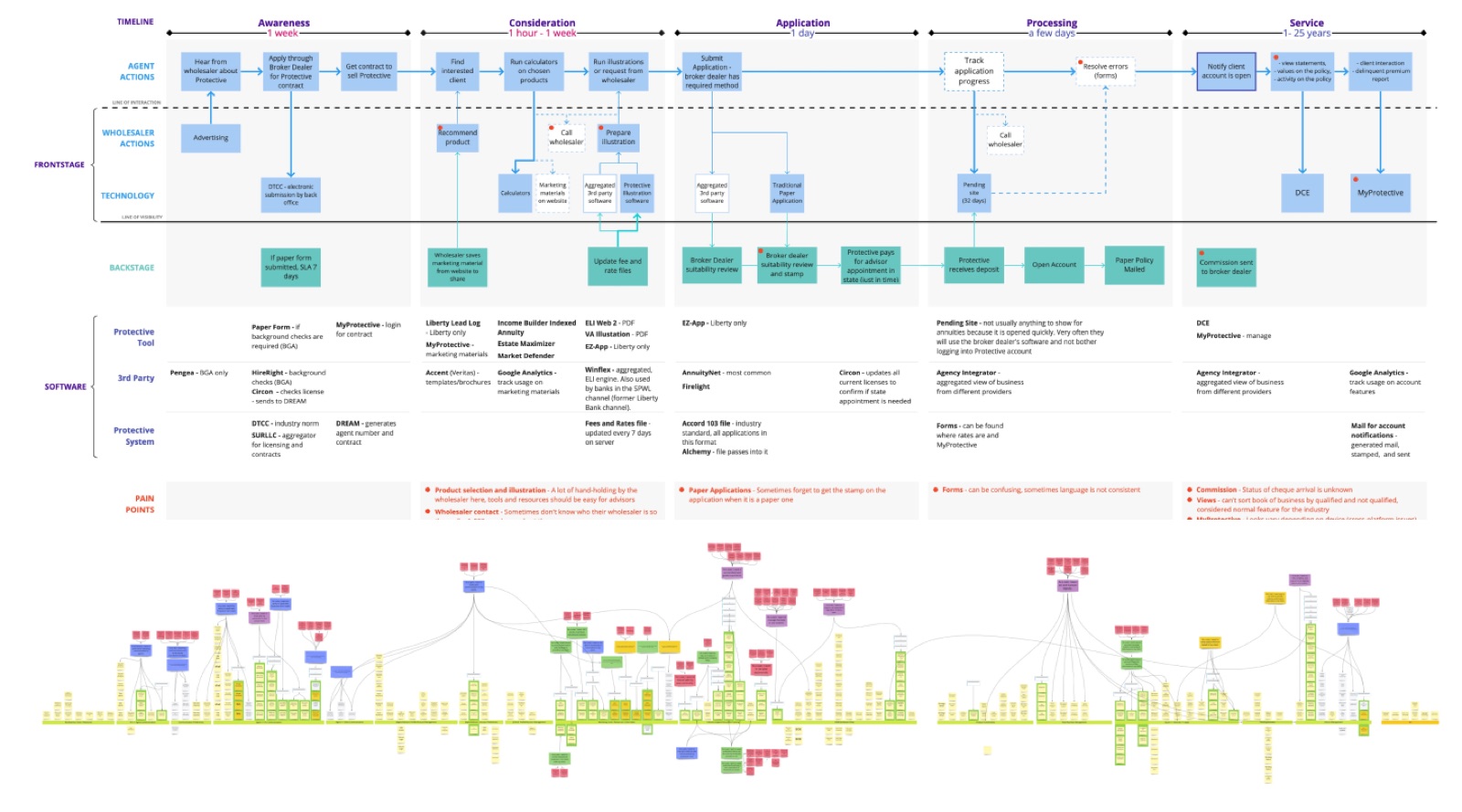
What changed
- 20%
- LOWER DEPARTMENTAL COST
- 60%
- LESS DEVELOPER DEPENDENCY
- 70+
- PROPERTIES IN ONE UNIFIED ECOSYSTEM
Business pattern
Technology modernization fails when the operating model that created the problem remains unchanged.
Included services.
Each has its own page.
Engagement.
Scoped to the problem, not a package.
Common starting points:
- operating-model assessment
- transformation strategy
- embedded leadership
- UX governance redesign
- enterprise design transformation

Senior work stays senior.
You work directly with Pavel Bukengolts, UXDL founder and principal, on assessment, major decisions, and direction. Specialist collaborators join when the work requires additional expertise or capacity.
Recognition
ADPList 100
Recognized among the top mentors on ADPList.
2026 GNTC Tech Educator of the Year
Finalist, Greater Nashville Technology Council.
UX Magazine contributor
Published on product, accessibility and AI practice.
Bring the pattern that keeps repeating across the organization.
Bring the product, workflow, delivery problem, or decision. No polished brief required.
Prefer email? [email protected]
Project inquiry
Thank you — your message is on its way.
I read every inquiry personally and usually reply within one business day.