
- AI
- AIGovernance
- Systems Thinking
The System Around the Work: Designing for Continuity and Judgment
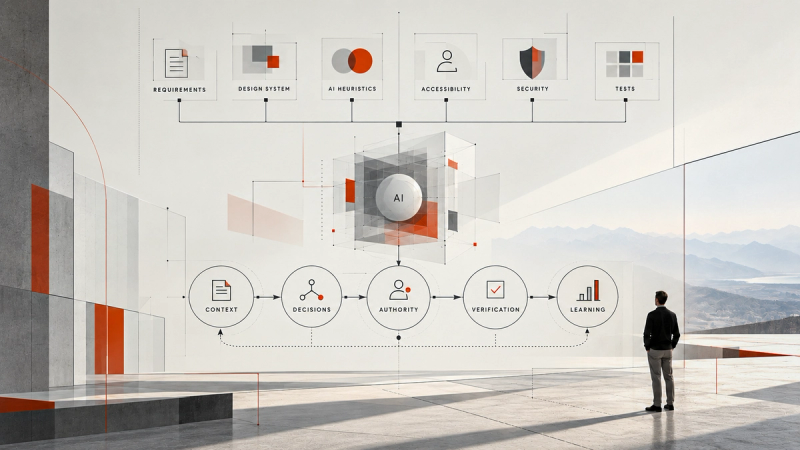
AI makes building easy. The harder problem is creating a system that preserves context, supports judgment, verifies work, and learns over time.
Briefing · Leadership / Transformation
Discover what clients truly need from agencies in the AI era, and how forward-thinking teams can deliver strategic value beyond automation.

As AI tools become standard across industries, many clients are questioning the role of agencies. But the truth is, they’re not rejecting help, they’re demanding better help. Let’s explore how agencies can shift from task execution to strategic orchestration, offering the clarity and critical thinking clients now expect.
I’ve been in this game long enough to remember when the biggest client question was: “Can you make this look good and work well?”
Now, I get a different question, and it’s landing with more force: “With all this AI, why do we even need an agency anymore?”
It’s not always confrontational. Often, it’s an honest, searching question. And it’s growing louder.
We all see it. AI is storming the creative space. LinkedIn is a dizzying highlight reel of Midjourney visuals, ChatGPT-powered brainstorms, instant Canva designs, and auto-optimized copy. Internally, many clients are already well into experimentation. Externally, they’re asking the tough questions. We’ve seen financial reports, like S4 Capital’s much-discussed revenue dip, which, while influenced by broader economic pressures, also signals a shift as clients reassess where their budgets go. It’s not just the economy; it’s the stark realization that many tasks agencies once billed heavily for are now becoming startlingly automated, fast, and cheap.
But here’s the critical insight, the one we need to tattoo on our agency walls: these clients aren’t saying they don’t need help. They’re saying they don’t need the same kind of help. They’re drowning in tools and data, but thirsting for wisdom.
The old model was often linear: creative concept → design → launch → report.
Agencies delivered execution. But when AI can generate a dozen concepts before your first coffee, and iterate designs in minutes, execution itself is no longer the primary currency.
What AI, for all its power, doesn’t intrinsically do is listen between the lines of a chaotic Slack channel. It doesn’t sense the unspoken anxieties of a leadership team or navigate the treacherous internal politics that can derail the most brilliant execution. It doesn’t, on its own, ask the right “Why?”
Clients aren’t just asking for work to be done. They’re wrestling with deeper challenges:
You don’t solve those with a single, simple prompt. You might use AI to explore facets of these problems, to model scenarios, or to synthesize vast amounts of data, but the framing, the strategic choices, and the empathetic connections? That’s a different league.
As one startup founder recently confessed, “We’ve got an arsenal of design and AI tools. What we don’t have is coherent strategic alignment. We’re building incredibly fast, but we’re terrified we’re building the wrong thing, or five different things.” That’s not a Midjourney problem. That’s a vision and integration problem.
Across countless engagements, a pattern emerges:
The real value isn’t just a design deliverable or a campaign. It is a design as a strategic discipline: delivering insight, fostering clarity, building alignment, and creating sustainable momentum. That only comes when you truly understand the multi-layered problem before proposing a solution.
Think about it: you don’t hire a cartographer just to draw a pretty map of a known trail. You hire them to explore uncharted territory, identify the right trail from countless possibilities, explain why it’s the right one, and help you navigate it safely and effectively, especially when the fog rolls in.
This is the evolved agency value proposition. Not only production, but also integrative strategic thinking and positioning. Not just shipping faster, but shaping better, more resilient strategies. This often means:
And yes, when we do this well, clients don’t need us in the same continuous, task-based way. They need us intensely at critical inflection points, when direction is dangerously unclear, when transformative change is non-negotiable, or when internal alignment has critically frayed.
Let’s be brutally honest: AI is here to stay, and it will automate or significantly streamline many traditional agency tasks. Entire roles and departments focused purely on rote execution will shrink or vanish. But so is ambiguity. So is complexity. So is the profound need for someone to cut through the noise, connect the dots, and say with authority, “This is what matters. This is the wisest next step. Here’s how we navigate the ethical tightropes.”
The agencies that thrive won’t be the ones stubbornly resisting AI. They’ll be the ones who:
This is what the modern agency must become: not a deliverable factory, but a decision-making ally and a strategic capability builder.
“The illiterate of the 21st century will not be those who cannot read and write, but those who cannot learn, unlearn, and relearn.”
Alvin Toffler.
This is our mandate.
Let’s talk. If you’re rethinking your team’s direction or grappling with how to build these future-critical capabilities to truly leverage AI, not just use it, let’s explore your next North Star.
Listen · AI-narratedSummary
0:00Keep reading
Selected from the same topics.
AI makes building easy. The harder problem is creating a system that preserves context, supports judgment, verifies work, and learns over time.

What changes when the distance between a question and what we can create to explore it begins to collapse, and judgment becomes a harder skill?

We cannot predict every way an AI agent might interpret us. The guardrail belongs where interpretation becomes a consequence.
Contact
Tell me what you are building, changing, or trying to make better. You do not need a polished brief.
Prefer email? [email protected]
I read every inquiry personally and usually reply within one business day.