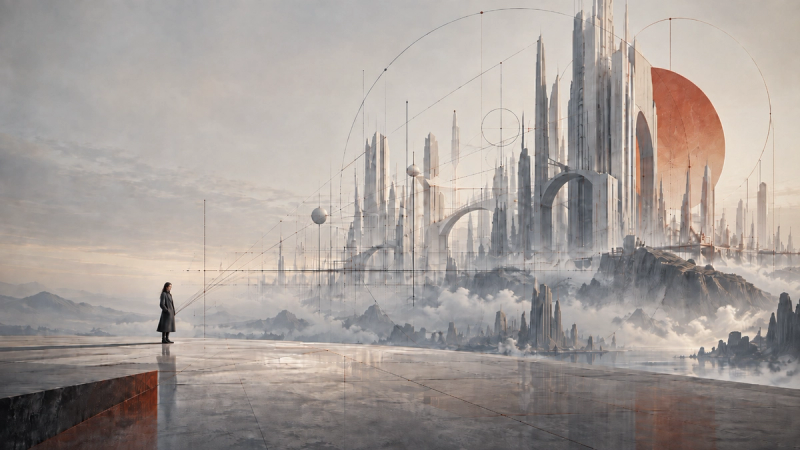
It is September 15, and it is still 100F (38°C) outside.
The heat has been hanging around for what feels like forever. At some point, I started wondering: is this actually unusual? Have we had stretches like this before? How late into September have temperatures stayed this high? Is my memory exaggerating it?
Normally, that question would send me searching. Google. Weather sites. Historical records. Fifteen browser tabs, probably, and an hour later, some version of an answer.
Except I didn't do that.
The question itself suggested a form: historical data, comparisons, a way to explore it. I described what I could already see in my head, then went back to what I was doing.
Less than an hour later, that mental picture existed as a working application.
What stayed with me wasn't the application. It was that my mind had skipped searching for an existing answer and gone almost directly from question to form.
For most of our lives, that wasn't a reasonable reflex. We lived among finished tools. Someone else made the book, the map, the calculator, the software. We learned what existed and adapted our problems to its shape.
Historically, considerable distance separated imagining something from making it exist. Between the two sat knowledge, practiced skill, labor, money, materials, and time.
My weather question moved differently. I described what I wanted and largely left. A few times I checked in, answered a question, corrected a direction, and went back to something else. When I returned, something that had existed as a question and a picture in my head had become something I could use.
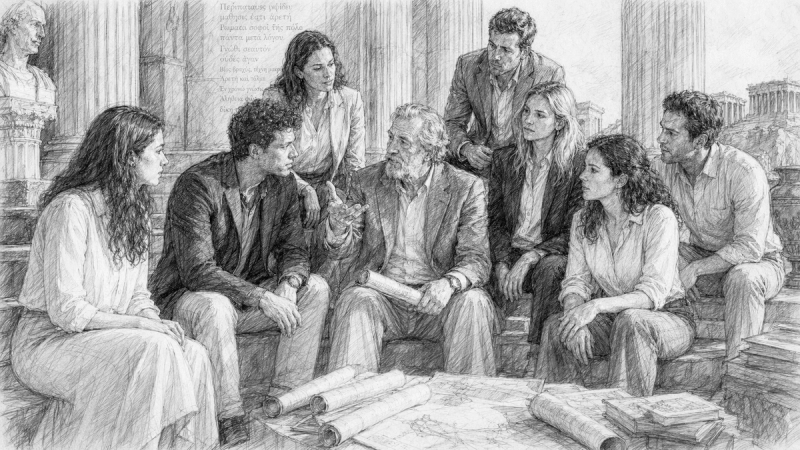
More than two thousand years ago, Zhuangzi told the story of Wheelwright Bian. A duke is reading the words of ancient sages while Bian works below him. Bian argues that the essential knowledge of his craft can't be captured in words. His hands know something his mouth cannot transmit, not even to his son.
By Bian's standard, I may not have made the thing at all. I put an intention into words and largely removed my hands from the work.
John Dewey lets me ask a different question: did I still conduct the inquiry?
For Dewey, inquiry isn't the same as personally performing every operation. We encounter an uncertain situation, form a problem, construct possibilities, reason through them, and test whether they actually help us understand it.
I delegated much of the execution. I didn't necessarily delegate the inquiry. But how much of the doing can I delegate before I am no longer the one doing the thinking?
Russian engineer and philosopher Pyotr Klimentievich Engelmeyer gives that question another shape. At the beginning of the twentieth century, he described creativity through three acts: desire, knowledge, and skill. The first forms the intention; the second develops and tests the project; the third realizes it.
What happened on my screen wasn't simply that the third act became faster. Parts of the second act, the movement from intention toward a workable form, were happening outside me too.
If knowledge and skill become increasingly available around us, more weight moves toward noticing the problem, asking the question, articulating what should exist, recognizing when the result is wrong, and deciding whether it should exist at all.
That last part matters because I nearly lost it myself. While writing this, I realized I had become more interested in how easily the instrument appeared than in the weather question that made me build it.
Heidegger, in The Question Concerning Technology, argued that technology isn't merely machinery. It is also a way of seeing, one that can make the world appear as something waiting to be ordered, shaped, and made available to us.
So perhaps the question
What would need to exist for me to understand this?
needs another one immediately behind it:
Why do I assume something needs to be made at all?
Something in how I respond to a question has shifted. It no longer has to send me first toward things other people have already made. The form itself can be negotiable.
That is liberating, but it removes some of the resistance that used to discipline thought. Making forced an intention through craft, constraints, failure, and other people's expertise. If some of that friction disappears, judgment doesn't become less important. It becomes easier to avoid.
Perhaps authorship begins to move with it: away from performing every act of construction and toward the quality of the question, the clarity of the intention, and the judgment applied to what comes back.
But that leaves me in an uncomfortable place. I have just relocated authorship toward articulation, toward words, and Bian's entire objection is that the most important part of knowing may be exactly what words cannot carry.
Yet his complaint is not simply against words. It is against mistaking words for the living knowledge that produced them. The skill of seeing what should exist, and recognizing when it doesn't, is no easier to pass on. It too is learned through years of trying against resistance.
My words stay alive only while I remain present to judge what comes back. When I stop, they become exactly what Bian saw in the duke's hands:
“only the dregs and sediments of those old men.”— Zhuangzi, “The Way of Heaven,” translated by James Legge, 1891
Sources
Zhuangzi, “The Way of Heaven,” James Legge translation, 1891:https://ctext.org/text.pl?if=en&node=42060
John Dewey, overview of his theory of inquiry:https://plato.stanford.edu/entries/dewey/
Pyotr Klimentievich Engelmeyer and his theory of creativity:https://www.gramota.net/article/hss20132448/fulltext
Martin Heidegger, The Question Concerning Technology; background:https://plato.stanford.edu/entries/heidegger/