
Product Strategy & Incubation
Choose what to build
Clarify the problem, test the riskiest assumptions, and build enough evidence to decide what should move forward.
Recognize the problem.
If two or more of these sound familiar, start here.
S/01
The roadmap is full, but priority changes every quarter.
S/02
A major initiative has executive support but limited evidence.
S/03
Different groups are defining the problem differently.
S/04
Research exists but has not resolved the decision.
S/05
A new initiative is approaching delivery before the assumptions have been tested.
What changes.
What is different when the work is done — things you can point to, not adjectives.
Change 01
Major initiatives have explicit decision criteria and success measures.
Change 02
Assumptions carrying the most financial or product risk are visible.
Change 03
Leadership can review a concrete experience before committing large delivery capacity.
Change 04
Work that cannot justify investment is removed, reshaped, or deferred.
How we work.
Assess. Align. Implement. Iterate. Applied to the work with the most at stake.
Assess
Review the existing evidence, roadmap, constraints, users, risks, and investment assumptions.
Align
Define the decision, product hypothesis, success measures, and unresolved questions.
Implement
Use research, modeling, prototyping, or incubation to test the questions carrying the most risk.
Iterate
Document decisions and evidence so the method can be repeated as the product evolves.
Proof.
Comparable work, with its provenance stated.
Proof · SERVICE DESIGN · Product Strategy & Incubation
De-risking a $900K build.
Context
A two-week service-design diagnostic identified that 42 of 45 documented pain points were process-based. The proposed software investment was halted, avoiding more than $900K in unnecessary build cost.
Provenance
Strategic product de-risking before build — measured during the engagement.Read the case: De-risking a $900K build. →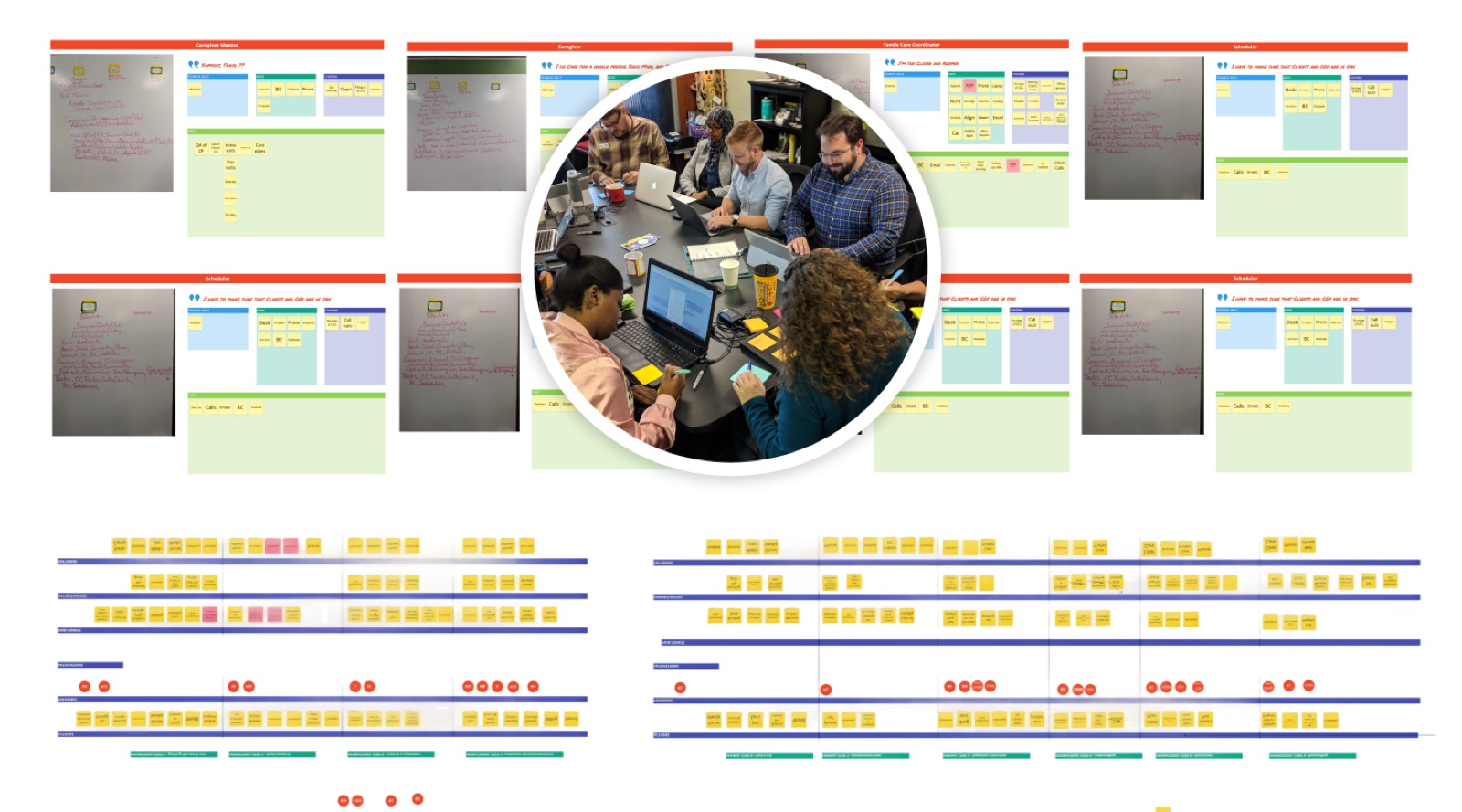
What changed
- 93%
- OF IDENTIFIED ISSUES WERE NON-TECHNICAL
- $900K+
- UNNECESSARY SOFTWARE INVESTMENT AVOIDED
- 2 WEEKS
- FROM BRIEF TO SHARED DIAGNOSIS
Business pattern
Large software investments carry unnecessary risk when the underlying service has never been mapped.
Included services.
Each has its own page.
- 01UX / Product StrategyClarify product direction, priorities, decision criteria, and measurable outcomes.Explore UX / Product Strategy →
- 02UX ResearchGet evidence behind an important product or service decision.Explore UX Research →
- 03Enterprise Product IncubationTurn a high-risk initiative into a testable experience and investment decision.Explore Enterprise Product Incubation →
Engagement.
Scoped to the problem, not a package.
Common starting points include a strategic assessment, focused research engagement, product-direction engagement, or incubation effort. Focused work generally runs for a few weeks. Larger initiatives are scoped after the first conversation.

Senior work stays senior.
You work directly with Pavel Bukengolts, UXDL founder and principal, on assessment, major decisions, and direction. Specialist collaborators join when the work requires additional expertise or capacity.
Recognition
ADPList 100
Recognized among the top mentors on ADPList.
2026 GNTC Tech Educator of the Year
Finalist, Greater Nashville Technology Council.
UX Magazine contributor
Published on product, accessibility and AI practice.
Bring the decision that keeps circling.
We can start with the roadmap, initiative, research, or disagreement and work backward to the evidence needed.
Prefer email? [email protected]
Project inquiry
Thank you — your message is on its way.
I read every inquiry personally and usually reply within one business day.