

- HumanCenteredAI
- Case Study
- AI
The Machine Gave Me Homework
I built an AI tool to preserve my writing voice. Instead, it taught me more about my writing habits, editorial decisions, and what makes words our own.
Briefing · Product Strategy / Experience Architecture
A conversation about AI and research involving 800 leaders raises a familiar question: are we solving a real problem, or finding work for a tool?
In a recent conversation with an executive at an engineering organization, we drifted toward AI. His organization hadn't done much with it yet, and he wondered whether AI could sort his emails, prioritize messages, find relevant information, and draft replies.
"You're asking the wrong question," I told him.
I wasn't dismissing his curiosity. I wanted to understand what he was trying to improve before recommending a solution. We hadn't established whether email was actually causing him problems, or what those problems might be.
I'm all for exploring new tools. Research and experimentation can reveal opportunities we couldn't have imagined before. But when exploration becomes implementation, we need evidence.
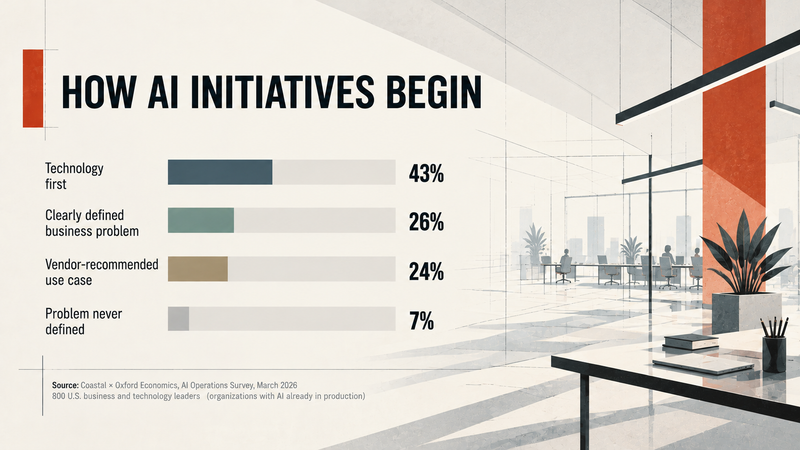
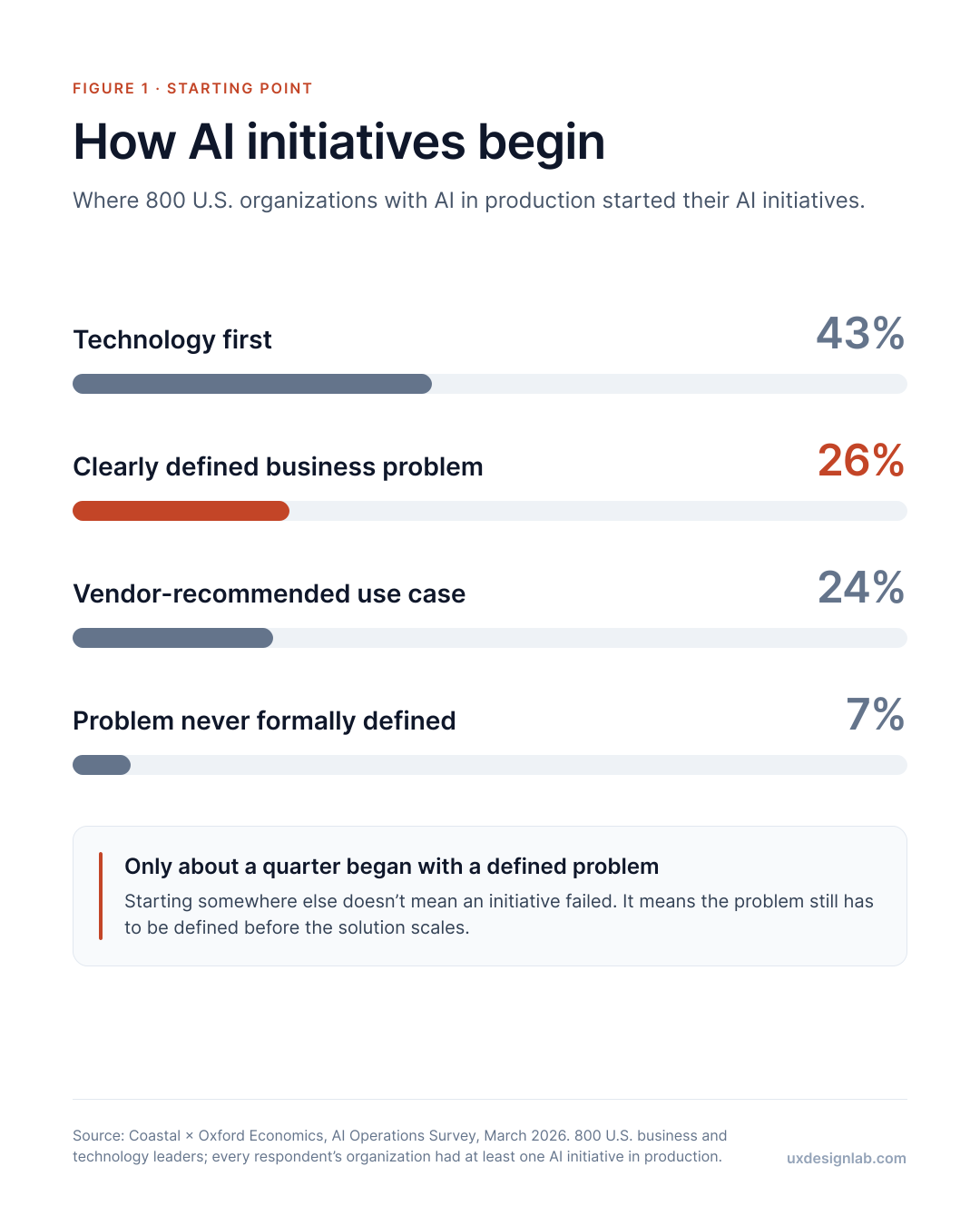
A 2026 study by Coastal and Oxford Economics surveyed 800 U.S. business and technology leaders whose organizations already had AI in production. Only 26% began with a clearly defined business problem. Another 43% started with the technology, 24% followed vendor-recommended use cases, and 7% never formally defined what they were trying to solve.
The more interesting finding is how those groups compare.
Confidence in scaling AI was nearly identical among problem-first and technology-first organizations, at 75% and 71%, respectively. It dropped to 55% for vendor-recommended use cases and 40% when the problem was never defined. Among those following vendor recommendations, 64% reported that the solution delivered less value than expected.
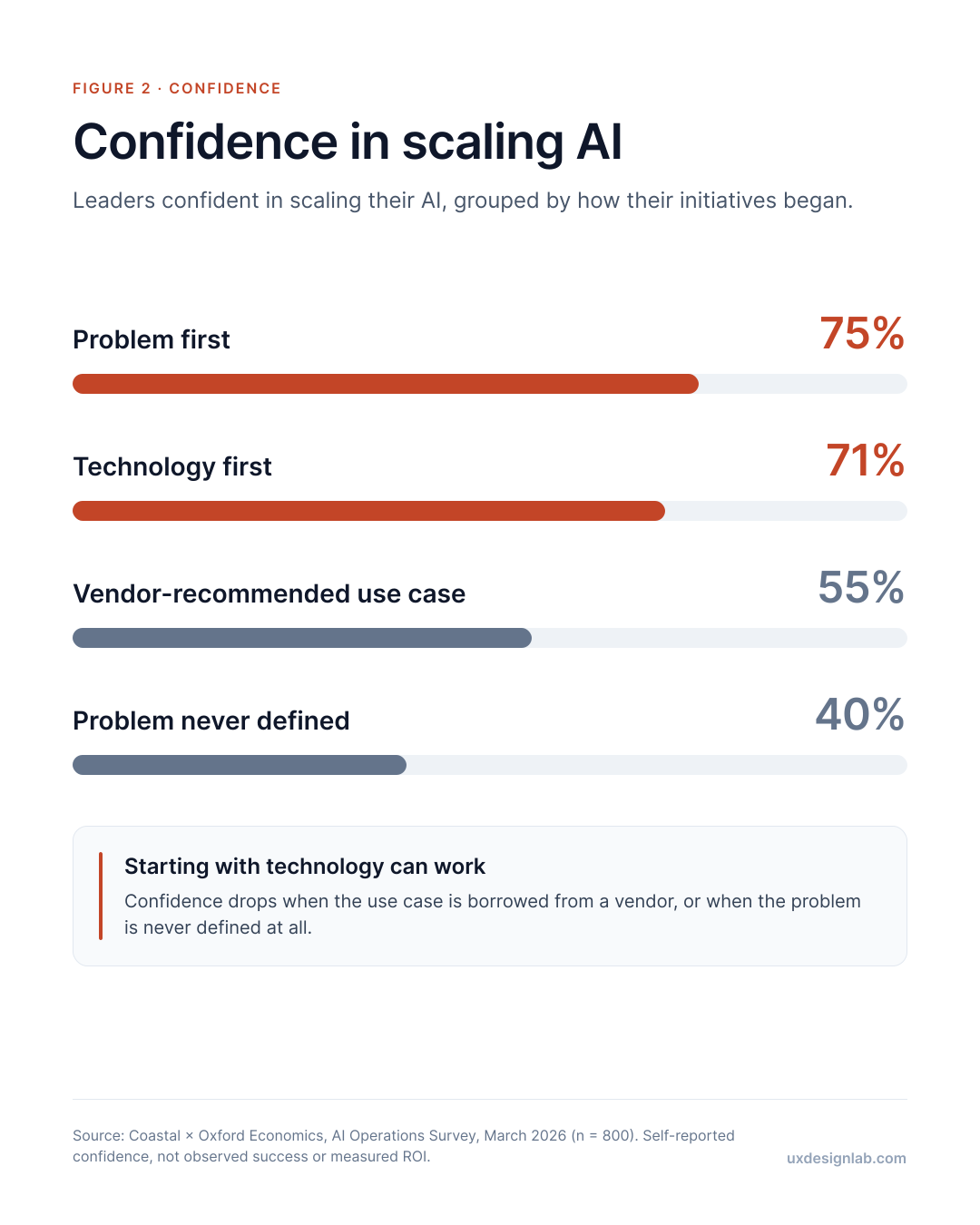
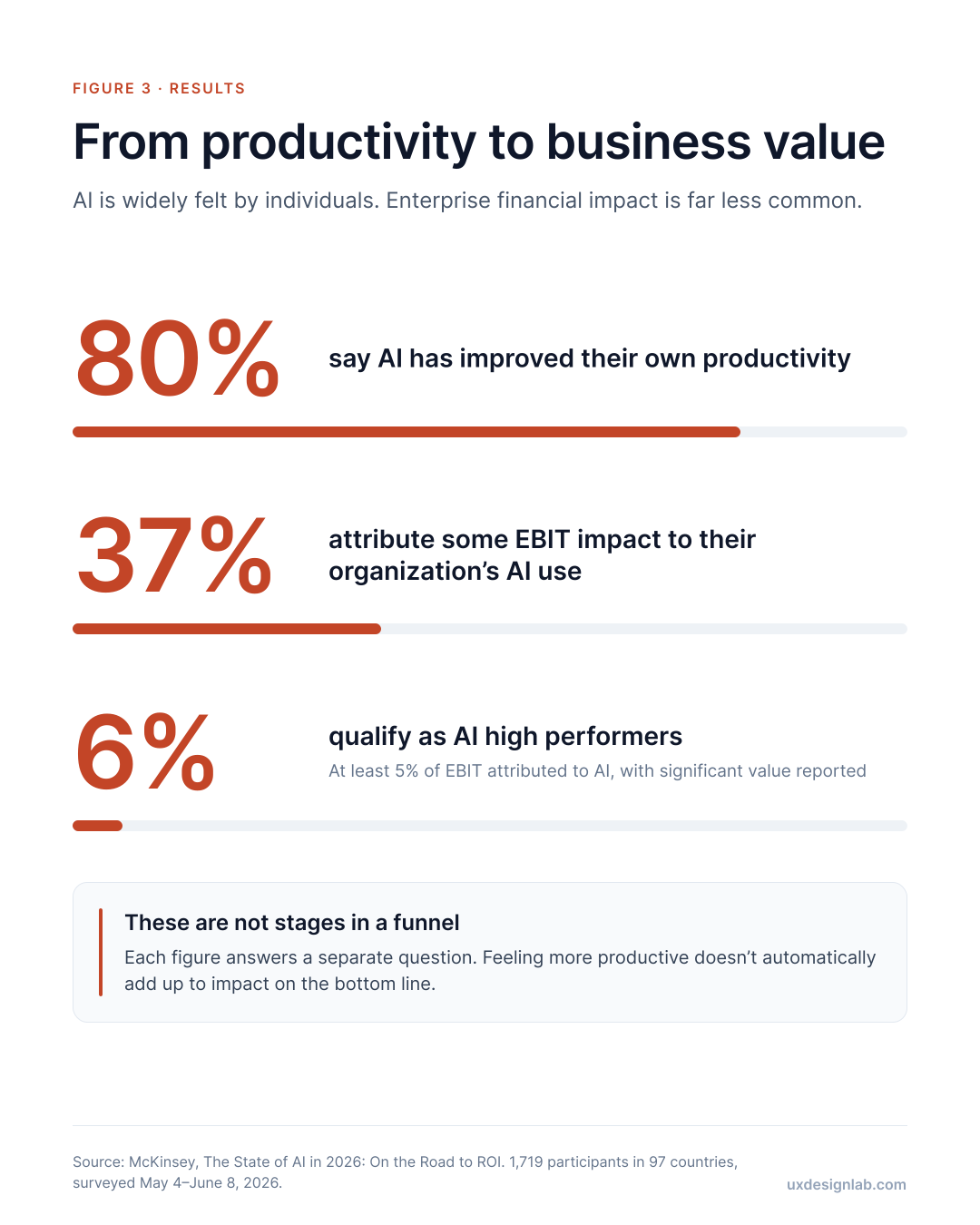
These are self-reported findings, and confidence isn't the same as business value. Still, the distinction is revealing. Starting with technology can lead somewhere useful. The risk is becoming so attached to a solution that we stop examining the problem.
Small inconveniences become business problems. Problems become projects. Eventually, we risk building perfectly functioning solutions to things nobody particularly needed fixing.
Back to my executive and his emails.
Suppose we spent a week observing how he manages his inbox. We might discover he's copied on dozens of conversations that don't require his attention. Perhaps decisions are delayed because nobody else has the authority to make them. Or maybe he really does spend ninety minutes every morning writing routine replies.
Each finding suggests a different approach.
The first might require better communication practices. The second calls for clearer decision-making authority. The third might benefit from AI, although templates, delegation, or simpler automation could accomplish the same thing.
Now we have something to investigate, test, and measure.
The principle applies at any scale: understand the actual work, identify where value is being lost, establish a baseline, and measure whether your intervention improves it. I've explored this further in Design Without Evidence Is Mostly Confidence.
Maybe my executive really does need AI to manage his inbox. We simply hadn't established what needed improving.
John Dewey put it rather well in 1938:
"To set up a problem that does not grow out of an actual situation is to start on a course of dead work."
John Dewey, Logic: The Theory of Inquiry
Listen · AI-narratedSummary
0:00Selected from the same topics.
I built an AI tool to preserve my writing voice. Instead, it taught me more about my writing habits, editorial decisions, and what makes words our own.

What changes when the distance between a question and what we can create to explore it begins to collapse, and judgment becomes a harder skill?

Why attention, conversation, and synthesis still need practice in the age of automation
Tell me what you are building, changing, or trying to make better. You do not need a polished brief.
Prefer email? [email protected]
I read every inquiry personally and usually reply within one business day.